<html><font size=8 face=“Arial”>Metapopulation</font></html>
Single Species
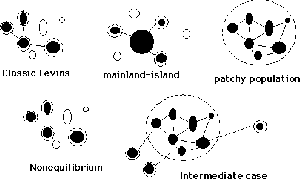 The basic models of metapopulations of a species are related to the proportion of patches occupied by a species determined by the balance between colonization and extinctions. We present in this topic three classic models of metapopulations in which colonization and extinction rates are modeled differently.
- Propagule Rain
-

The first proposed model, in which the rates of extinction and colonization are constant and equal for all patches of habitat.

- Internal Colonization
-
 In this variant of the basic model, the colonization rate depends on the number of occupied sites. It describes a closed system, in which the source of propagules is the system's own patches.

- Rescue Effect
-

If more spots are occupied, the migration to empty spots increases, but also to the already occupied spots. This can lower the risk of extinction. This exercise deals with this modification of the model, which is called the rescue effect.

Two-species
 Extensions of basic metapopulation models to more than one species.
We have a set of patches that can be colonized by two or more interacting species. We also explored the effect of stain removal, which represents the destruction of natural habitats.
Extensions of basic metapopulation models to more than one species.
We have a set of patches that can be colonized by two or more interacting species. We also explored the effect of stain removal, which represents the destruction of natural habitats.
- Coexistence in Metapopulations
-
 In this simulation we add a competitively inferior species to the model of metapopulations with internal colonization. Find out how to make the two species coexist.
- Habitat Destruction
-
 In the previous model of metapopulation coexistence, habitat destruction by human action can be represented as removal of patches. Investigate its effects.
